

Introduction
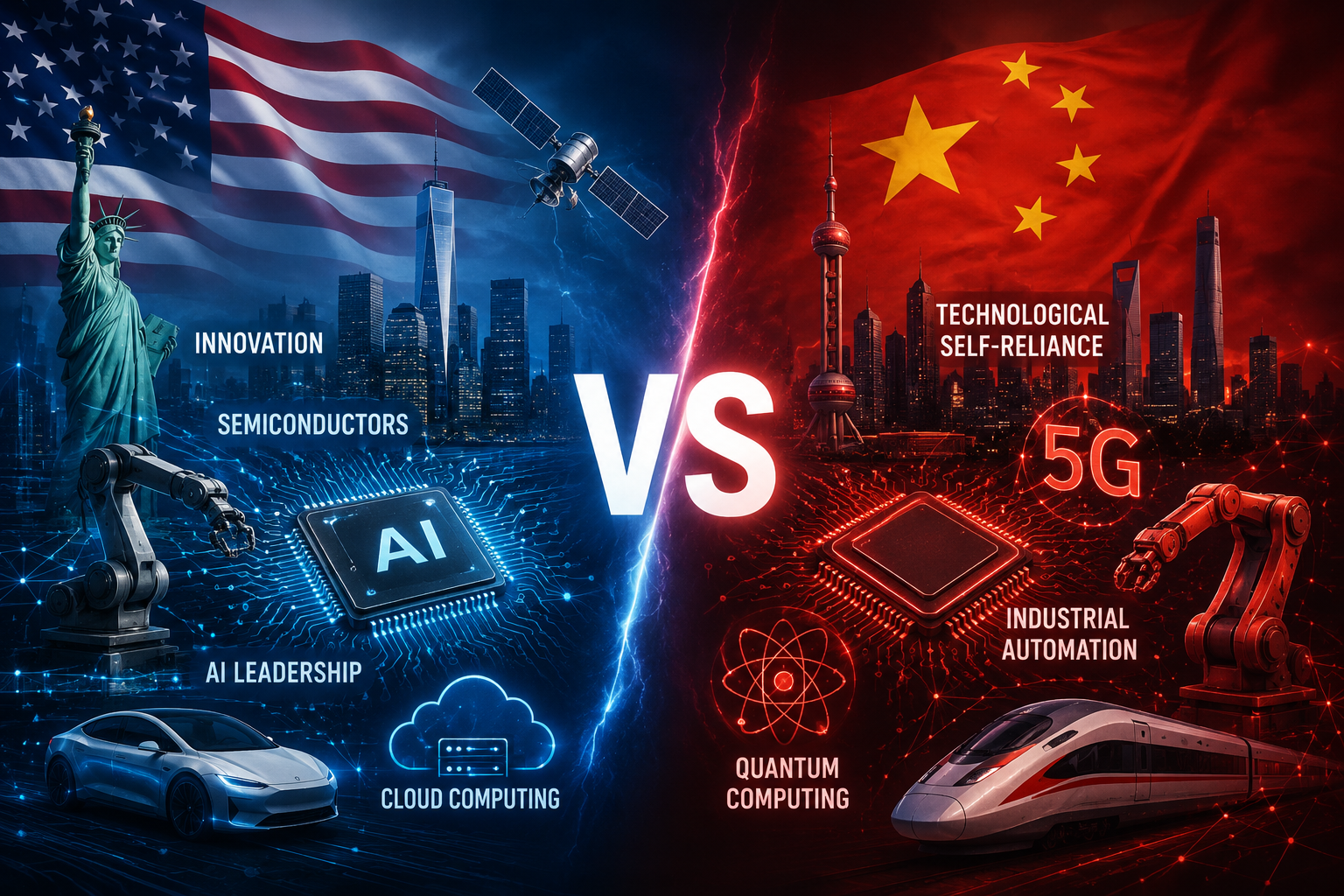
The competition between the United States and China has become one of the defining features of international affairs in the twenty-first century. While geopolitical rivalry among major powers is not new, the current phase of competition differs from previous eras because technology has emerged as its central arena. Artificial intelligence, semiconductors, quantum computing, advanced telecommunications, biotechnology, cloud infrastructure, and cybersecurity are no longer viewed solely as commercial sectors. Increasingly, they are regarded as strategic assets that shape economic strength, military capability, political influence, and national resilience.
Unlike traditional geopolitical rivalries that were often defined by territorial disputes or military alliances, the contemporary contest between Washington and Beijing is deeply intertwined with technological innovation. Both countries recognize that leadership in critical technologies may influence the future global balance of power. As a result, governments, corporations, research institutions, and investors are dedicating unprecedented resources toward securing technological advantages.
At the same time, the competition is more complex than a simple struggle for dominance. The United States and China remain economically interconnected, and many global industries depend on cooperation between firms, researchers, and supply chains located in both countries. This creates a unique dynamic in which competition and interdependence coexist. Understanding the nature of the US–China technology competition therefore requires examining not only strategic rivalry but also the broader economic and technological systems that connect the world’s two largest economies.
The Origins of Technological Competition
The roots of the current competition can be traced to China’s rapid economic transformation during the late twentieth and early twenty-first centuries. For decades, China served primarily as a manufacturing center within global supply chains. Its integration into the global economy generated extraordinary economic growth and enabled the development of increasingly sophisticated industrial capabilities.
As China’s technological capacity expanded, its ambitions also evolved. Policymakers began placing greater emphasis on innovation, research, advanced manufacturing, and digital technologies. Significant investments were directed toward universities, research institutions, industrial modernization, and emerging technology sectors. Over time, Chinese companies became major competitors in areas ranging from telecommunications equipment and e-commerce platforms to renewable energy technologies and artificial intelligence applications.
Meanwhile, the United States remained the world’s leading center for technological innovation. American universities, venture capital networks, research laboratories, and technology firms continued to produce groundbreaking advances across multiple sectors. Silicon Valley became synonymous with digital innovation, while American companies played central roles in shaping the global internet economy.
Technology as a Source of National Power
Historically, nations derived power from geography, military strength, natural resources, and economic output. In the modern era, technological capability has become an equally important international affairs in the twenty-first century. While geopolitical rivalry among major powers is not new, the current phase of competition differs from previous eras because technology has emerged as its central arena. Artificial intelligence, semiconductors, quantum computing, advanced telecommunications, biotechnology, cloud infrastructure, and cybersecurity are no longer viewed solely as commercial sectors. Increasingly, they are regarded as strategic assets that shape economic strength, military capability, political influence, and national resilience.
Unlike traditional geopolitical rivalries that were often defined by territorial disputes or military alliances, the contemporary contest between Washington and Beijing is deeply intertwined with technological innovation. Both countries recognize that leadership in critical technologies may influence the future global balance of power. As a result, governments, corporations, research institutions, and investors are dedicating unprecedented resources toward securing technological advantages.
At the same time, the competition is more complex than a simple struggle for dominance. The United States and China remain economically interconnected, and many global industries depend on cooperation between firms, researchers, and supply chains located in both countries. This creates a unique dynamic in which competition and interdependence coexist. Understanding the nature of the US–China technology competition therefore requires examining not only strategic rivalry but also the broader economic and technological systems that connect the world’s two largest economies.
The Origins of Technological Competition
The roots of the current competition can be traced to China’s rapid economic transformation during the late twentieth and early twenty-first centuries. For decades, China served primarily as a manufacturing center within global supply chains. Its integration into the global economy generated extraordinary economic growth and enabled the development of increasingly sophisticated industrial capabilities.
As China’s technological capacity expanded, its ambitions also evolved. Policymakers began placing greater emphasis on innovation, research, advanced manufacturing, and digital technologies. Significant investments were directed toward universities, research institutions, industrial modernization, and emerging technology sectors. Over time, Chinese companies became major competitors in areas ranging from telecommunications equipment and e-commerce platforms to renewable energy technologies and artificial intelligence applications.
Meanwhile, the United States remained the world’s leading center for technological innovation. American universities, venture capital networks, research laboratories, and technology firms continued to produce groundbreaking advances across multiple sectors. Silicon Valley became synonymous with digital innovation, while American companies played central roles in shaping the global internet economy.
As China’s capabilities expanded, however, policymakers in Washington increasingly viewed technological development not merely as an economic issue but also as a strategic challenge. Concerns emerged regarding industrial competitiveness, intellectual property protection, supply chain security, and the long-term implications of China’s technological rise. These concerns laid the foundation for a broader technological competition that continues today.
Technology as a Source of National Power
Historically, nations derived power from geography, military strength, natural resources, and economic output. In the modern era, technological capability has become an equally important source of influence. Countries that lead in advanced technologies often enjoy advantages in productivity, innovation, military modernization, and international competitiveness.
Artificial intelligence provides a clear example. AI systems have the potential to transform industries ranging from healthcare and finance to logistics and manufacturing. They can improve efficiency, accelerate scientific discovery, and enhance decision-making processes. At the same time, AI applications increasingly influence defense planning, intelligence analysis, cybersecurity operations, and autonomous systems.
Semiconductors represent another critical domain. Advanced chips serve as the foundation for nearly every modern digital technology. Control over semiconductor design, manufacturing, and supply chains has therefore become a strategic priority. Similar dynamics are visible in quantum computing, biotechnology, telecommunications infrastructure, and advanced materials
The competition between the United States and China reflects a broader recognition that technological leadership increasingly shapes national power in the twenty-first century.
Artificial Intelligence as a Strategic Battleground
Artificial intelligence has become one of the most visible dimensions of the US–China technology competition. Both countries possess significant strengths in AI development, though their approaches differ.
The United States benefits from world-class universities, leading technology companies, extensive venture capital networks, and a culture that encourages innovation and entrepreneurship. American firms have played central roles in developing advanced machine learning models, cloud computing platforms, and AI-driven applications.
China, meanwhile, has invested heavily in AI as part of broader national development strategies. Large digital ecosystems, extensive data resources, and substantial government support have contributed to rapid progress in AI research and deployment. Chinese companies have achieved notable success in areas such as computer vision, digital payments, e-commerce, and smart city technologies.
Rather than focusing solely on which country is ahead at any given moment, many analysts emphasize the different strengths each possesses. The United States often maintains advantages in foundational research and advanced model development, while China demonstrates strengths in implementation, scale, and integration across large populations.
Rather than focusing solely on which country is ahead at any given moment, many analysts emphasize the different strengths each possesses. The United States often maintains advantages in foundational research and advanced model development, while China demonstrates strengths in implementation, scale, and integration across large populations.
The Semiconductor Dimension
Few sectors illustrate the strategic nature of technological competition more clearly than semiconductors. Advanced chips are essential for artificial intelligence, cloud computing, telecommunications networks, military systems, and consumer electronics.
The semiconductor industry is highly globalized, involving research, design, manufacturing, equipment production, and supply chain coordination across multiple countries. Nevertheless, concerns about technological dependence have encouraged both Washington and Beijing to strengthen domestic capabilities.
The United States maintains significant advantages in semiconductor design, software tools, and advanced manufacturing equipment. American firms remain central players in many segments of the global semiconductor ecosystem.
China, meanwhile, has invested heavily in developing indigenous semiconductor capabilities. Reducing dependence on foreign technologies has become a strategic objective, particularly as advanced chips become increasingly important for economic and military applications.
The semiconductor sector demonstrates how technological competition increasingly intersects with questions of economic security and national resilience.
Telecommunications and Digital Infrastructure
The competition between the United States and China also extends to telecommunications infrastructure. Fifth-generation mobile networks, cloud computing platforms, undersea cables, data centers, and digital services have become important components of global connectivity.
Digital infrastructure influences economic activity, information flows, and technological development. Countries that provide critical infrastructure may gain economic opportunities and strategic influence.
The debate surrounding telecommunications infrastructure reflects broader concerns about cybersecurity, data governance, resilience, and technological standards. Different countries have adopted varying approaches when evaluating suppliers and managing digital infrastructure development.
As discussions regarding sixth-generation communications technologies begin to emerge, competition in this sector is likely to remain significant
Economic Interdependence and Strategic Rivalry
One of the most unusual aspects of the US–China technology competition is the degree of economic interdependence that exists alongside strategic rivalry. Unlike some historical geopolitical competitions, the two countries remain deeply integrated through trade, investment, research collaboration, and supply chains.
Many technology products depend on components, expertise, and markets located in both countries. Universities, corporations, and research institutions have historically benefited from international cooperation.
This interdependence creates both opportunities and challenges. On one hand, collaboration can accelerate innovation and generate economic benefits. On the other hand, policymakers increasingly worry about vulnerabilities associated with dependence on external suppliers and critical technologies.
As a result, many governments are exploring ways to enhance resilience while preserving the benefits of international cooperation.
The Role of Talent and Research
important dimensions of technological competition. Breakthrough innovations depend on scientists, engineers, entrepreneurs, and researchers capable of generating new ideas and transforming them into practical applications.
The United States has long attracted international talent through its universities, research institutions, and technology sector. This openness has contributed significantly to American technological leadership.
China has also invested extensively in education, research infrastructure, and talent development. The number of graduates in science, technology, engineering, and mathematics disciplines has expanded dramatically, supporting the country’s growing innovation ecosystem.
The competition for talent is therefore becoming increasingly important. Nations capable of attracting, retaining, and developing highly skilled individuals may enjoy long-term advantages in technological innovation.
Cybersecurity and Digital Security
Cybersecurity has become another major area of competition. Governments increasingly view cyberspace as an important domain of national security and economic activity.
Digital systems underpin financial networks, communications infrastructure, transportation systems, healthcare services, and government operations. Consequently, cybersecurity vulnerabilities can have far-reaching consequences.
Both the United States and China invest heavily in cyber defense capabilities, while international discussions continue regarding norms, responsibilities, and acceptable behavior in cyberspace.
The growing importance of cybersecurity highlights how technological competition extends beyond economic concerns into broader questions of stability and security.
Global Implications
The consequences of US–China technological competition extend far beyond the two countries themselves. Governments around the world are navigating a rapidly changing technological landscape shaped by innovation, strategic competition, and evolving governance frameworks.
Many countries seek to maintain constructive relationships with both powers while pursuing their own technological development strategies. Emerging economies are increasingly investing in digital infrastructure, artificial intelligence, advanced manufacturing, and research capabilities.
The competition also influences international standards, investment flows, supply chain decisions, and global innovation networks. As technology becomes more deeply integrated into international affairs, its impact on global governance is likely to grow.
Future Scenarios
Several potential trajectories could shape the future of the US-China technology competition. One possibility involves intensified rivalry characterized by increasing technological separation and competing innovation ecosystems. Another involves managed competition, where strategic rivalry coexists with selective cooperation in areas of mutual interest.
A third scenario involves greater international coordination around shared challenges such as AI governance, cybersecurity, climate technology, and scientific research. While competition would remain, mechanisms for cooperation could help reduce risks and support global stability.
The actual outcome will likely incorporate elements of all three scenarios, reflecting the complexity of modern international relations.
Conclusion
The US-China technology competition represents one of the most significant geopolitical developments of the modern era. At stake is not simply commercial success but the future distribution of technological, economic, and strategic power. Artificial intelligence, semiconductors, digital infrastructure, cybersecurity, and emerging technologies have become central arenas in a broader contest that will shape the global landscape for decades to come.
Yet the competition is not purely a zero-sum struggle. The United States and China remain connected through complex economic, technological, and academic relationships. Their interactions influence global innovation, international governance, and economic development in ways that affect countries around the world.
The future of this competition will depend on how both nations balance rivalry with cooperation, national interests with global responsibilities, and technological ambition with long-term stability. As technology becomes increasingly central to international affairs, understanding this relationship will remain essential for policymakers, businesses, researchers, and citizens alike.





Leave a Reply