

Executive Summary
Artificial intelligence has become one of the most influential technologies of the 21st century, but an increasingly important debate is emerging around how AI should be developed and distributed. At the center of this discussion are two competing approaches: open source AI models and closed proprietary AI systems.
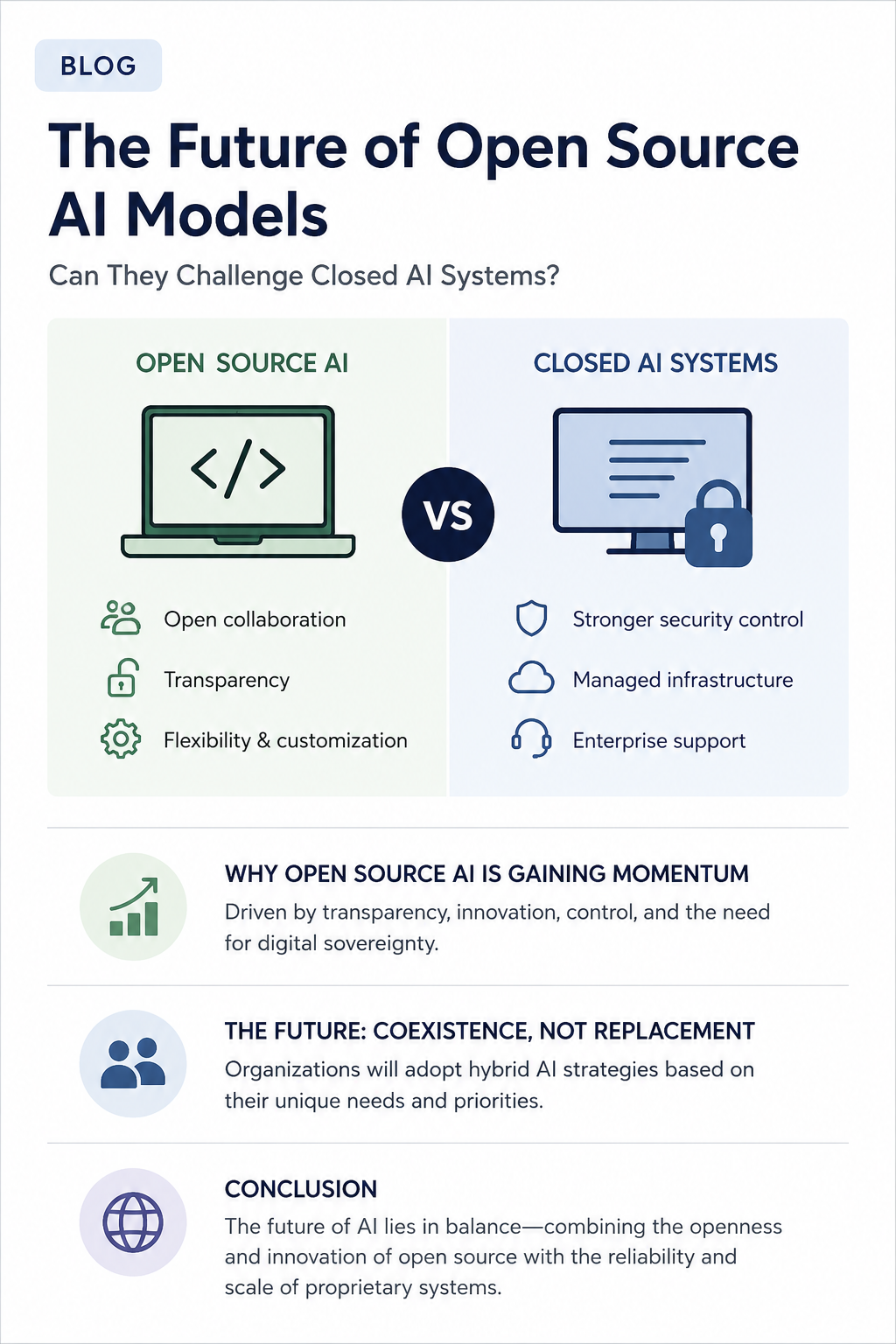
Open source AI allows researchers, developers, startups, universities, and businesses to inspect, modify, and deploy AI models with varying degrees of transparency. Closed AI systems, on the other hand, are generally controlled by private companies that limit access to model architecture, training methods, or weights while offering AI through commercial products and APIs.
Both approaches have advantages. Open source encourages collaboration, transparency, and innovation, while proprietary systems often provide stronger commercial support, managed infrastructure, and integrated enterprise services.By mid-2026, this debate is no longer theoretical.
Governments, enterprises, researchers, investors, and developers increasingly view the balance between open and closed AI as a strategic issue affecting innovation, economic competitiveness, national security, and digital sovereignt
This report examines how open source AI is evolving, why enterprises are increasingly interested in it, the challenges it still faces, and whether it has the potential to compete with proprietary AI ecosystems over the coming years.
Introduction
Artificial intelligence has traditionally been associated with large technology companies possessing enormous computing resources, proprietary datasets, and highly specialized engineering teams. Developing advanced AI systems required billions of dollars in investment, making participation difficult for smaller organizations.
That landscape is changing.
The rapid growth of open source AI communities has democratized access to increasingly capable models. Universities, startups, independent researchers, and enterprise developers now contribute to a global ecosystem that accelerates innovation through collaboration rather than secrecy.
Open source software has already transformed operating systems, cloud computing, databases, programming languages, cybersecurity, and enterprise infrastructure. Many experts believe artificial intelligence could follow a similar path.
However, AI introduces new challenges that traditional open source software never faced.
Large AI models require enormous computational resources, extensive safety testing, continuous updates, and responsible governance. Simply making a model publicly available does not automatically guarantee trustworthy or secure deployment.
The central question therefore becomes whether openness alone is sufficient to compete with highly integrated commercial AI platforms.
Why Open Source AI Has Gained Momentum
Several factors explain the rapid growth of open AI development.
First, organizations increasingly seek independence from individual technology vendors. Relying exclusively on proprietary AI services can create long-term dependence regarding pricing, infrastructure, and future product direction.
Open models provide greater flexibility.
Businesses can customize models for specific industries, deploy them within private infrastructure, integrate proprietary data securely, and optimize performance for specialized tasks.
Second, researchers benefit from transparency.
Access to model architecture enables scientific validation, reproducibility, benchmarking, and collaborative improvement.
Academic institutions have historically relied on openness to accelerate discovery, making open AI particularly attractive for research environments.
Third, governments increasingly recognize the strategic importance of domestic AI capability.
Supporting open AI ecosystems allows countries to strengthen innovation without depending entirely on foreign commercial platforms.
This has elevated open source AI from a technical preference to a matter of economic and technological resilience.
Innovation Through Global Collaboration
One of open source AI’s greatest strengths is its collaborative nature.
Thousands of developers worldwide contribute improvements, identify bugs, optimize performance, translate documentation, build specialized tools, and create industry-specific adaptations.
Instead of innovation occurring within a single company, progress emerges from distributed global collaboration.
This model often accelerates experimentation.
Researchers can rapidly test new ideas without waiting for commercial product roadmaps.
Startups can build innovative services on existing models instead of developing every component independently.
Enterprises can customize solutions for healthcare, manufacturing, education, finance, legal services, or scientific research.
This collaborative ecosystem encourages diversity in AI applications while reducing barriers to entry.
The pace of innovation frequently exceeds expectations because improvements originate simultaneously from universities, research laboratories, independent developers, nonprofit organizations, and commercial companies.
Enterprises Want Greater Control
Enterprise adoption represents one of the strongest drivers of open source AI growth.
Large organizations increasingly handle sensitive customer information, financial records, healthcare data, intellectual property, and confidential business strategies.
Many prefer deploying AI within private infrastructure rather than transmitting data to external cloud services.
Open models provide greater deployment flexibility.
Organizations can operate AI within secure environments, integrate internal databases, customize workflows, and comply with sector-specific regulatory requirements.
This flexibility is particularly valuable in industries where privacy, security, and compliance remain critical business priorities.
Instead of accepting standardized commercial AI services, enterprises increasingly seek models optimized for their unique operational requirements.
Transparency Builds Trust
Transparency has become one of the defining themes of AI governance.
Organizations, regulators, and customers increasingly expect greater visibility into how AI systems are developed, evaluated, and deployed.
Open AI contributes to this objective by allowing broader examination of model behavior.
Researchers can evaluate strengths, limitations, biases, security vulnerabilities, and performance across diverse applications.
Independent validation strengthens scientific credibility while improving public confidence.
Transparency also supports education.
Students, engineers, and researchers gain valuable experience studying real AI architectures rather than relying solely on theoretical documentation.
As AI literacy expands globally, openness may play an increasingly important role in workforce development.
The Economics of Open AI
Open source does not necessarily mean free.
Developing advanced AI models requires enormous investment in computing infrastructure,
engineering talent, energy, research, and continuous optimization.
Many organizations therefore pursue hybrid business models.
Core AI models may remain openly available while companies generate revenue through enterprise support, managed hosting, premium tools, consulting services, security features, and commercial integrations.
This approach resembles successful business strategies previously adopted within cloud computing, Linux distributions, enterprise databases, and developer platforms.
The challenge lies in maintaining sustainable funding while preserving openness that encourages widespread collaboration.
Can Open Source AI Match Proprietary Systems?
One of the biggest questions facing the AI industry is whether open source models can truly compete with proprietary systems in terms of capability, reliability, and enterprise readiness.
A few years ago, the answer appeared relatively straightforward. Closed AI platforms generally maintained a significant advantage because they possessed larger research teams, access to massive computing infrastructure, proprietary datasets, and substantial financial resources. Their models consistently demonstrated superior reasoning, coding, multilingual understanding, and enterprise integration.
By 2026, however, the gap has narrowed considerably.
Open source communities have improved the quality of language models at an impressive pace. Researchers around the world continuously optimize model architectures, improve inference efficiency, develop better fine-tuning techniques, and create specialized versions designed for healthcare, education, finance, software engineering, and scientific research.
This rapid innovation demonstrates one of the greatest strengths of open collaboration.
Instead of depending on a single organization’s roadmap, improvements originate simultaneously from universities, startups, nonprofit organizations, independent researchers, and commercial contributors.
Nevertheless, proprietary AI systems continue to maintain important advantages.
Large commercial providers often invest heavily in safety testing, infrastructure optimization, enterprise support, multilingual capabilities, large-scale deployment, and continuous model updates. Businesses operating mission-critical applications frequently value these managed services as much as model performance itself.
The competition therefore is no longer about which approach will completely replace the other. Instead, the future is likely to involve coexistence, with organizations selecting different AI strategies according to their operational requirements.
Security and Responsible AI Development
Greater openness naturally introduces additional security considerations.
When powerful AI models become widely accessible, malicious actors may attempt to exploit them for harmful purposes, including phishing campaigns, malware development, automated misinformation, identity fraud, or other forms of cybercrime.
Supporters of proprietary AI argue that controlled access reduces opportunities for misuse by allowing providers to monitor usage and implement centralized safeguards.
Advocates of open source AI present a different perspective.
They argue that transparency enables broader security research. Independent experts can identify vulnerabilities, evaluate model behavior, recommend improvements, and strengthen defenses more rapidly than closed development environments.
History provides examples supporting both viewpoints.
Open source software has often demonstrated strong security because global communities continuously inspect code and report vulnerabilities. At the same time, openness requires responsible governance, documentation, and ongoing maintenance to ensure that discovered issues are addressed promptly.
Future AI governance will likely emphasize responsible release practices, security testing, usage guidance, and collaborative risk mitigation rather than treating openness itself as either inherently safe or inherently dangerous.
Governments Are Increasingly Interested in Open AI
Artificial intelligence has become a strategic national capability.
Governments increasingly recognize that dependence on a small number of foreign commercial AI providers may create long-term economic and technological risks.
As a result, many countries are investing in domestic AI research ecosystems, national computing infrastructure, university partnerships, and open innovation initiatives.
Open source AI supports several public policy objectives.
It encourages education by allowing students and researchers to study advanced models.
It strengthens local innovation ecosystems by reducing barriers for startups.
It enables public institutions to customize AI solutions according to national languages, legal systems, and cultural requirements.
It also supports digital sovereignty by reducing reliance on external technology providers.
Rather than viewing open source AI solely as a software development model, policymakers increasingly consider it part of broader national technology strategies.
Enterprise Adoption Will Continue to Expand
Businesses are no longer asking whether they should adopt artificial intelligence.
Many enterprises now implement hybrid approaches.
General productivity tasks may rely on commercial AI platforms offering managed infrastructure and enterprise support.
Sensitive internal operations, however, increasingly use privately deployed open source models customized for specific organizational needs.
This hybrid strategy offers several advantages.
Organizations maintain flexibility while reducing vendor dependence.
Confidential business information remains within private infrastructure.
Models can be optimized for industry-specific terminology, workflows, compliance requirements, and internal knowledge bases.
Large enterprises increasingly establish dedicated AI governance teams responsible for selecting, evaluating, deploying, monitoring, and continuously improving AI systems regardless of whether they originate from open or proprietary ecosystems.
The Business Models Behind Open AI
A common misconception is that open source AI cannot generate sustainable revenue.
In reality, many successful technology companies have demonstrated that openness and commercial success can coexist.
Rather than charging for software licenses alone, organizations increasingly generate revenue through:
• Enterprise support services
• Managed cloud hosting
• Security monitoring
• Premium enterprise features
• AI consulting
• Custom model development
• Fine-tuning services
• Industry-specific AI solutions
• Developer platforms
• Training and certification
This approach resembles successful business models previously established in cloud computing, enterprise Linux, database technologies, and developer infrastructure.
As AI adoption expands, service quality may become as important as the underlying model itself.
Challenges That Open Source AI Must Overcome
Despite remarkable progress, several significant challenges remain.
Sustainable Funding
Training advanced foundation models requires enormous computational resources.
Long-term financial sustainability remains a critical concern for many open AI initiatives.
AI Safety
Open models require rigorous evaluation to reduce harmful outputs, bias, misinformation, and security vulnerabilities.
Community collaboration helps, but structured governance remains essential.
Compute Infrastructure
Access to advanced computing hardware remains concentrated among relatively few organizations.
Expanding access to AI infrastructure will influence future competitiveness.
Regulatory Compliance
Organizations deploying open AI must still comply with privacy laws, cybersecurity standards, intellectual property regulations, and sector-specific requirements.
Compliance responsibilities remain with the deploying organization regardless of licensing model.
What Will the AI Landscape Look Like by 2030?
Several long-term trends are becoming increasingly apparent.
Open source AI will continue expanding across education, research, startups, government projects, and enterprise customization.
Proprietary AI platforms will likely maintain leadership in integrated commercial ecosystems, managed enterprise services, and large-scale infrastructure.
Rather than one model replacing the other, the future AI ecosystem is expected to become increasingly diverse.
Organizations will select AI solutions according to business priorities including privacy, flexibility, scalability, security, cost, regulatory compliance, and performance.
Competition between open and closed ecosystems will likely accelerate innovation for both.Consumers, businesses, researchers, and governments may ultimately benefit from having multiple high-quality AI ecosystems rather than a single dominant approach.
Consumers, businesses, researchers, and governments may ultimately benefit from having multiple high-quality AI ecosystems rather than a single dominant approach.
Frequently Asked QuestionsIs open source AI free?
Not always. While many models are available without licensing fees, organizations may still incur costs related to computing infrastructure, customization, support, deployment, and ongoing maintenance.
Is open source AI safer than proprietary AI?
Neither approach is inherently safer. Security depends on governance, testing, deployment practices, monitoring, and responsible use rather than licensing alone.
Why are enterprises interested in open AI?
Open AI provides greater flexibility, deployment control, customization, privacy, and reduced dependence on individual vendors.
Open AI provides greater flexibility, deployment control, customization, privacy, and reduced dependence on individual vendors.
Will proprietary AI disappear?
Highly unlikely. Commercial AI providers continue offering valuable enterprise infrastructure, managed services, technical support, and integrated digital ecosystems.
Conclusion
The debate between open source and proprietary artificial intelligence is not a contest with a single winner. Instead, it represents two complementary approaches to advancing one of the world’s most transformative technologies.
Open source AI has already demonstrated its ability to accelerate innovation, expand educational opportunities, strengthen research collaboration, and enable organizations to build customized AI solutions tailored to their specific needs. At the same time, proprietary AI systems continue to provide enterprise-grade infrastructure, extensive safety investments, managed services, and integrated digital ecosystems that many organizations value.
The future of artificial intelligence is therefore unlikely to be defined by complete dominance from either side. Instead, businesses, governments, researchers, and developers will increasingly adopt hybrid strategies that combine the flexibility of open source with the operational reliability of commercial platforms.
Looking toward 2030, the most successful AI ecosystem may not be the one that is entirely open or entirely closed. It will be the one that best balances innovation, transparency, security, sustainability, and public trust. As artificial intelligence becomes deeply embedded in every sector of the global economy, that balance will shape not only the future of technology but also the future of digital society itself.





Leave a Reply