

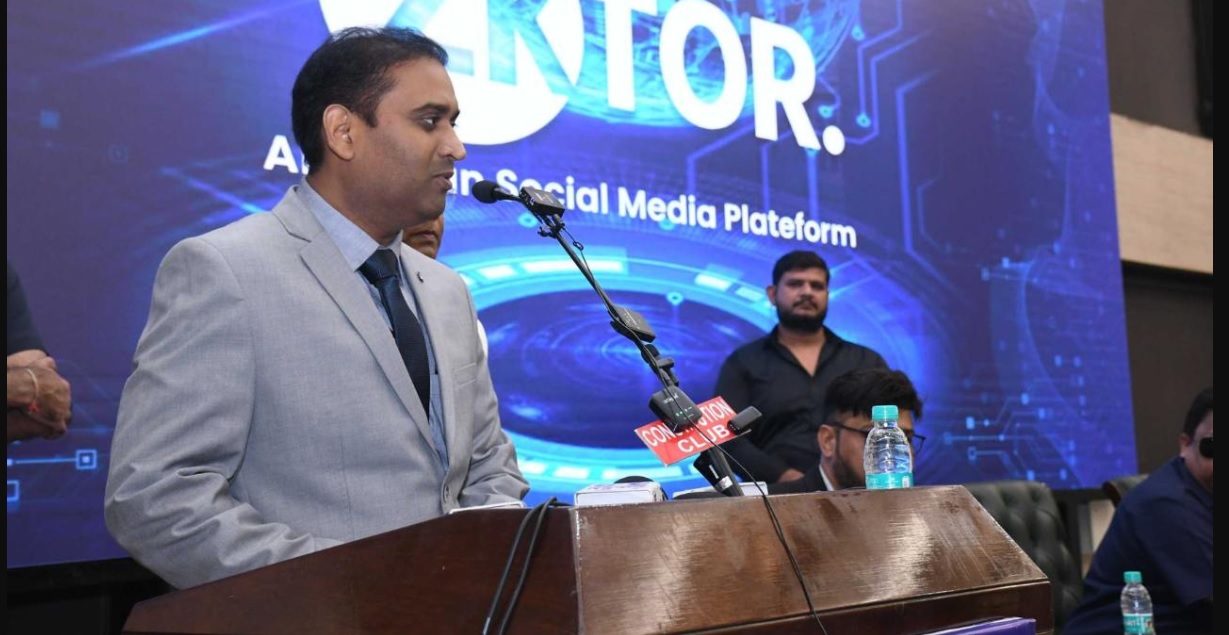
During mass public testing across South Asia, the Bharat-built super social-media platform has drawn strong confidence from Gen Z, young women and regional communities, while founder Sunil Kumar Singh connects Zero Knowledge security, No URL Media Architecture, sovereign AI, hyperlocal journalism, contextual advertising, local commerce and rural production through an independent, no-VC and ISRO-inspired technology model
NEW DELHI, SPECIAL NEWS ANALYSIS
ZKTOR has approached one million cumulative downloads during its South Asia mass public testing phase, giving Softa Technologies Limited a substantial consumer base for one of India’s most ambitious privacy-first technology projects. The all-in-one platform combines end-to-end encrypted private and group messaging, audio and video calls, feeds, photographs, status updates, reels, long-form videos, pages, clubs, communities, creator tools and local discovery within a single secure Indian social network. Early participation across India, Nepal, Bangladesh and Sri Lanka has been led strongly by Gen Z users and young women, placing the platform at the intersection of the region’s two most consequential digital shifts: the arrival of an AI-native generation and the growing demand for social participation that does not require the surrender of privacy, identity or human dignity. Gulf News previously documented ZKTOR’s four-country beta expansion and the strong response from these user groups, while the current download milestone shows that the initial interest has widened into mass public testing.
The number is important because it validates more than another social-media application. ZKTOR has entered public testing with an architecture that challenges the business logic on which the first era of social platforms was built. Instead of treating private communication, personal relationships, photographs, location, interests and behaviour as a permanent corporate resource, Softa has designed the platform around privacy and data safety by design, Zero Knowledge Server Architecture, No URL Media Architecture, data minimisation, restricted internal access, user-controlled visibility and no profiling-based monetisation. The platform’s social functions remain familiar, but the institution behind them is deliberately constrained. ZKTOR does not ask users to trust that every future executive, investor, contractor or external authority will exercise restraint. Its architecture reduces the amount of sensitive power available to them in the first place. Softa’s published technical framework describes servers as structurally limited in their ability to read or interpret protected user content and places user intent, rather than behavioural manipulation, at the centre of visibility and discovery.
That distinction has become commercially and socially decisive in the artificial intelligence age. A photograph is no longer only an image. A reel is no longer only entertainment. A voice clip is no longer only communication. Each can provide the face, speech pattern, location, professional context and behavioural detail required to manufacture a convincing synthetic identity. Relationships reveal which family member, manager, customer or public figure an attacker should impersonate. Creator media can be copied into fraudulent advertisements. A merchant’s video can be converted into a fake storefront. A student’s photograph can be altered into sexualised material. A journalist’s voice can be placed inside a fabricated political statement. AI has therefore converted ordinary social participation into a potential source of deepfakes, voice cloning, identity fraud, reputational sabotage and automated persuasion. ZKTOR’s competitive value lies in recognising that AI-age safety must begin before information is extracted, not after the resulting abuse has already crossed several networks.
Softa has embedded that prevention-first principle inside a wider ecosystem rather than limiting it to one secure application. ZKTOR provides protected social identity, communication and community. HOLA AI provides culturally grounded, voice-oriented and human-governed intelligence. Subkuz provides privacy-respecting hyperlocal and diaspora journalism. ZHAN provides contextual and hyperlocal advertising without behavioural surveillance. Ezowm provides merchant-sovereignty and local-commerce infrastructure. Green Gold extends the architecture into rural production, botanical value chains, processing and traceability. The products serve different markets, but they share one institutional rule: integration must not become unrestricted personal-data concentration. A private conversation does not become advertising intelligence, a news-reading history does not become a political profile, a commercial transaction does not control unrelated social visibility, and agricultural records do not become general corporate property.
This is the foundation of Softa’s trust-technology proposition. The company is not positioning privacy as a defensive shield around a conventional business model. It is turning privacy, digital dignity, regional relevance and institutional restraint into drivers of user acquisition, creator retention, merchant participation, advertiser confidence, bank adoption and government interest. Families recommend platforms they consider safe. Women participate more confidently where media and identity receive stronger protection. Creators build more durable audiences where original work is harder to extract. Merchants invest in digital identity where the platform does not erase the enterprise behind the listing. Institutions adopt technology more readily when data boundaries are understandable. Trust becomes measurable commercial capital, creating what may become Softa’s most valuable long-term asset: a trust premium generated by the architecture itself.
Privacy and data safety become infrastructure
The term privacy by design is frequently used to describe settings, consent screens and legal commitments added around systems whose primary commercial logic remains extensive data collection. ZKTOR applies a more structural interpretation. Its Zero Knowledge Server Architecture limits the central platform’s ability to read or interpret protected content. End-to-end encryption protects private communications. Multi-layer encryption and segmented information reduce the concentration of sensitive material. Restricted internal interfaces narrow what operational staff can access. User-controlled public, friends-only and private settings preserve the social boundary chosen at publication. Region-bound data governance keeps storage and operational authority connected to jurisdiction rather than creating one universal behavioural pool. These elements establish privacy and data safety as infrastructure rather than a promise dependent on changing corporate preferences.
This architecture changes the relationship between the user and the company. A conventional platform may possess broad technical visibility while promising not to misuse it. ZKTOR reduces the visibility available to the platform, aligning its operational power with the rights it promises users. The distinction gives the platform relevance far beyond consumer privacy. Banks can use secure communication without contributing customer conversations to an advertising profile. Schools and universities can create verified communities without converting students into commercial behavioural categories. Public institutions can maintain authenticated channels without requiring a global social graph. Creators and merchants can separate public identity from protected communication. Families can use one social environment for private calls, groups, media and communities while retaining clear audience controls.
The data-minimisation principle also creates a cybersecurity advantage. An institution that stores less unnecessary information exposes less material when systems are attacked or internal permissions are misused. The value does not come only from stronger encryption. It comes from refusing to accumulate information that the immediate service does not require. ZKTOR’s approach therefore addresses external hacking, insider risk, secondary commercial use and future institutional pressure through the same design philosophy. The platform is safer not simply because it places more locks around a large behavioural warehouse, but because it avoids constructing that warehouse as the economic centre of the company.
This restraint also protects Softa’s artificial-intelligence model from becoming dependent on uncontrolled personal data. HOLA AI gains capability through language, context and defined use cases rather than through permanent observation of private users. ZHAN gains commercial relevance from subject, language, geography and immediate market context rather than psychological prediction. Subkuz gains audience through public-interest information rather than reader profiling. Ezowm gains transaction value through verified commerce rather than unrelated social behaviour. Green Gold gains agricultural intelligence through productive records rather than ownership of the producer’s complete digital identity. The ecosystem is connected operationally, but its data architecture remains purpose-bound.
No URL Media Architecture closes the conventional leakage route
No URL Media Architecture is ZKTOR’s most distinctive user-facing innovation and one of Softa’s strongest global technology claims. Conventional platforms commonly deliver photographs, reels and videos through addressable media resources that browsers, applications and automated collection systems can retrieve. Even when a visible download button is absent, the underlying file may remain accessible through a conventional media address. ZKTOR removes that standard public URL and shareable-link pathway, keeping media inside the platform’s controlled delivery environment according to the audience selected by the publisher. Softa’s governance framework states that the model prevents external extraction and reduces non-consensual redistribution, particularly where photographs and videos may be used for harassment, coercion or unauthorised sharing.
The architecture directly addresses data leaks and media leaks that occur through public links, automated scraping and mass harvesting. A photograph or reel remains visible to the intended audience without becoming an ordinary publicly addressable internet file. This distinction is crucial in an era when automated systems can collect millions of images faster than any individual user can detect or challenge the activity. By closing the conventional URL-based extraction route, ZKTOR materially restricts the supply chain through which personal media is assembled into facial databases, synthetic-content factories, copied creator libraries, fraudulent commercial accounts and unauthorised AI-training collections.
The commercial importance extends beyond privacy. A creator’s photographs, voice, performances, educational videos and public identity are intellectual and economic assets. A merchant’s product reels and professional image create customer trust. A journalist’s authentic voice and face carry public authority. A teacher’s educational media carries institutional credibility. No URL Media Architecture protects these assets at the delivery layer, giving ZKTOR a credible position as an anti-scraping social platform, anti-deepfake infrastructure, authenticity-first social network and AI-age identity-protection system.
The system also changes the meaning of public participation. Visibility no longer automatically means unrestricted extractability. A woman entrepreneur can display a product without placing the source file on a conventional public link. A creator can build reach while retaining stronger control over original media. A family can share photographs within a selected community without creating an ordinary downloadable URL. A rural producer can document work without making every face, location and practice available for mass harvesting. ZKTOR preserves expression while reducing the technical convenience of appropriation.
This is particularly important for women and girls because the social cost of media misuse is distributed unequally. A manipulated photograph can affect education, employment, family relationships, marriage, business credibility and public leadership. Sexualised deepfakes and identity-based abuse are increasingly used to silence women from journalism, politics, entrepreneurship and professional life. Softa’s architecture treats women’s digital dignity as an engineering requirement. No URL Media protection, encrypted communication, restricted internal access, audience controls and accountable review work together before a photograph or reel becomes a weapon.
Safety without surveillance
A privacy-first social platform must address harassment, fraud, non-consensual sexual material, identity theft, communal incitement and organised abuse without turning lawful private activity into a continuous surveillance feed. ZKTOR’s safety architecture separates targeted intervention from universal monitoring. Automated systems assist with defined risk signals and content categories, while consequential decisions follow human review, documented reasoning, proportional action and an appeals pathway. This structure gives the platform a due-process identity that is increasingly important for creators, merchants, journalists and institutions whose livelihood or authority depends on continued access to their digital identity.
Human-reviewed moderation also provides stronger protection against coordinated reporting campaigns. Complaint volume alone does not determine truth. Regional language, satire, cultural expression, journalism, education and political discussion require context that automated systems often misunderstand. A culturally informed review model can distinguish harmful behaviour from lawful expression more accurately while preserving an appeal route for incorrect decisions. ZKTOR therefore positions itself as responsible social media with accountable enforcement rather than as a system in which hidden algorithms exercise unchallengeable authority.
HOLA AI supports this process as a bounded intelligence layer. It assists with regional-language interpretation, suspicious patterns, accessibility, manipulated-media signals and urgent-case prioritisation, but it does not replace human judgement in decisions affecting identity, audience, livelihood or access. The distinction is central to Softa’s AI philosophy. Intelligence provides assistance; accountable people exercise consequential power. This is human-governed AI, not punitive automation.
Safety without surveillance also strengthens institutional adoption. A bank, school, newsroom or public body needs protection against impersonation and fraud, but it does not need a platform that turns every lawful interaction into a behavioural profile. ZKTOR’s architecture connects verified public identity, encrypted direct communication, controlled media delivery and human-reviewed enforcement. The result is an institutional trust platform capable of supporting secure public channels, authenticated communication and national cyber resilience without requiring blanket monitoring.
A complete super social-media app
ZKTOR’s approach towards one million downloads also demonstrates that privacy has been placed inside a full consumer product rather than a narrow security utility. Google Play describes it as an Indian social and chat application combining secure conversations, status, reels and communities, while Apple presents it as a social environment connecting private interaction, creative expression and discovery. The platform provides the functions users already expect from modern social media while embedding stronger control over how identity, media and relationships move through the system.
This all-in-one design reduces the friction normally associated with privacy-first technology. A user does not need one application for encrypted communication, another for reels, a third for community and a fourth for creator activity. A family can communicate and share selected media inside one trusted environment. A creator can publish, operate a club, interact with followers and maintain secure professional conversations. A merchant can build public identity, communicate with customers and connect with local demand. A school, bank or public institution can maintain a verified presence while using protected direct channels.
The super social-media model is especially suited to Bharat and South Asia, where users operate across low-cost Android devices, uneven network quality, shared family settings, multiple scripts and sharply different levels of digital literacy. A privacy system becomes socially relevant only when the protected choice is understandable and convenient. ZKTOR’s familiar interface and integrated feature set turn privacy from a specialist concern into an ordinary product experience.
The platform also rejects several mechanisms associated with the attention economy. Softa’s published model places user intent above algorithmic manipulation and rejects behavioural tracking as the basis of content visibility. The resulting semantic position is powerful: no outrage amplification, no addictive engagement engineering, no hidden behavioural scoring, no psychological targeting and no dark-pattern growth. ZKTOR offers meaningful engagement, direct relationships and community relevance rather than maximising time spent through emotional pressure.
This gives ZKTOR a distinctive youth proposition. Gen Z and Generation Alpha inherited algorithmic feeds before they had any meaningful opportunity to choose how those systems worked. ZKTOR retains the creative tools, reels, communities and public identity young users value, but places them inside a platform designed around agency rather than manipulation. It is a Gen Z trust platform and a post-algorithm social network, not a retreat from digital culture.
South Asian youth become creators, operators and owners
Nearly one million downloads during mass public testing indicate that South Asian youth are not treating privacy as an abstract legal concern. They are responding to a platform that connects safety with creation, community, identity and opportunity. Gulf News documented strong early participation from Gen Z and young women across ZKTOR’s initial South Asian beta markets, establishing a user pattern directly aligned with Softa’s design priorities.
The wider economic value lies in converting young users from attention inventory into active participants. A regional-language creator can build an audience and commercial identity. A student can develop a portfolio without making private relationships part of an advertising dossier. A local journalist can distribute district reporting. A merchant can build a verified business community. A campaign professional can work with ZHAN. A language specialist can contribute to HOLA AI. A reporter or editor can work through Subkuz. A young agricultural professional can support Green Gold’s processing and traceability networks.
This structure gives Softa a youth-economy narrative stronger than conventional user growth. The platform does not create value only when a young person watches another reel. It creates value when that person produces, reports, translates, moderates, designs, sells, verifies, manages or processes something inside the ecosystem. Every such role deepens the network while creating income, skills and professional authority.
The employment architecture is inherently distributed. ZKTOR requires local-language trust and safety, community management, grievance handling and creator support. HOLA AI requires dialect experts, voice specialists, cultural reviewers and knowledge stewards. Subkuz requires district reporters, editors, translators and fact-checkers. ZHAN requires campaign professionals, designers, advertiser-verification teams and local market advisers. Ezowm requires merchant onboarding, catalogue operations, customer support, fulfilment and dispute resolution. Green Gold requires agronomists, laboratory staff, quality officers, traceability professionals, processors and logistics networks.
Local knowledge therefore becomes a technology skill. A person who understands a district’s language, culture, institutions and market is not a peripheral worker. That knowledge is essential to moderation, journalism, advertising, commerce and rural production. Softa’s hyperlocal model creates a trust workforce distributed beyond Bengaluru, Hyderabad, Gurugram and other major technology centres, allowing high-value work to remain closer to the communities being served.
Women’s digital dignity becomes economic infrastructure
Women are central to the Softa model because digital safety determines whether millions of potential creators, professionals and entrepreneurs participate fully in the online economy. A platform may offer global reach, but that reach has limited value if a woman must expose personal media, location, family information and private communication to gain it. ZKTOR connects protected identity with public visibility, allowing women to create, teach, report, sell and build professional communities inside a system designed to reduce extraction and profiling.
The economic implications are substantial. World Bank data show that India’s female labour-force participation remained far below male participation in 2025, while the institution has argued that raising women’s participation to 50 per cent could add roughly one percentage point to annual GDP growth. Digital work and commerce can lower barriers associated with mobility, geography and access, but only when the digital environment does not replace those barriers with identity theft, harassment and unsafe exposure.
ZKTOR supplies the protected social and communication layer. ZHAN supplies customer discovery through context instead of vulnerability profiling. Ezowm supplies commerce while separating business identity from unnecessary personal exposure. HOLA AI supplies regional-language and practical assistance. Subkuz supplies credible public visibility. Green Gold supplies rural employment, processing, laboratory, quality and ownership roles. The combined pathway connects women’s digital dignity with creator income, home-based enterprise, local commerce, agricultural value and national productivity.
Family trust strengthens this pathway. In South Asia, family concerns often influence whether girls and young women participate publicly online. A platform associated with encrypted communication, controlled media, no behavioural tracking and accountable moderation gives families a stronger basis for supporting public participation. This creates organic adoption through trusted relationships, reducing dependence on expensive paid acquisition.
Women’s participation also strengthens every Softa product commercially. It expands the creator base, merchant base, advertising inventory, news audience, rural workforce and professional talent pool. Safety therefore becomes a growth strategy. The company does not protect women despite its commercial objectives. It creates commercial value because the architecture allows women to participate with greater confidence.
HOLA AI: sovereign intelligence with defined authority
HOLA AI is Softa’s culturally grounded and purpose-bound intelligence layer, built for the languages, voices, knowledge systems and practical conditions of Bharat and South Asia. Its strategic importance lies in refusing the assumption that the most advanced AI is necessarily the system with the broadest access to the individual. HOLA AI is organised around bounded authority. It assists with language, accessibility, safety, journalism, commerce and agricultural knowledge without claiming unlimited rights over the data surrounding the user.
Inside ZKTOR, HOLA AI supports regional-language understanding, manipulated-media detection, safety signals and accessibility. Inside Subkuz, it supports transcription, translation and research while editors retain editorial authority. Inside ZHAN, it assists campaign creation and language adaptation without reading private messages or constructing psychological profiles. Inside Ezowm, it assists merchant onboarding, catalogues and customer communication. Inside Green Gold, it supports records, interpretation, traceability and access to agricultural knowledge.
This architecture positions HOLA AI within several high-value technology categories at once: sovereign AI, privacy-preserving AI, culturally aligned AI, voice-first AI, responsible AI, human-governed AI, Indic language intelligence and knowledge sovereignty. Its value comes from understanding the local context while accepting limits on what it may access and decide.
South Asia’s linguistic complexity makes that distinction commercially important. Language carries humour, dialect, community memory, local measurements, agricultural terminology, religious meaning and social hierarchy. Literal translation does not produce genuine cultural intelligence. HOLA AI turns regional knowledge into product capability while keeping human review and community context central.
Purpose separation protects the ecosystem from becoming a centralised data machine. Private social communication does not become advertising intelligence. Reading history does not become ideological classification. Commercial transactions do not control unrelated discovery. Agricultural records remain linked to production and producer value. The intelligence layer connects Softa’s products without dissolving the boundaries among them.
Subkuz makes information part of the infrastructure
Subkuz gives Softa an information layer built around hyperlocal reporting, diaspora connection, reader privacy and editorial independence. Its published principles include information as public infrastructure, journalism without behavioural extraction, credibility over virality and technology in the service of journalism. The platform is designed to connect district realities with national and global audiences without turning readers into profiling targets.
The economic role of this journalism is larger than media distribution. Local commerce depends on credible information about markets, public services, roads, education, health, agriculture, regulation and community events. Citizens require verified information. Merchants require market visibility. Governments and investors require evidence of local outcomes. Diaspora communities require current knowledge of their places of origin. A hyperlocal newsroom reduces uncertainty across all of these relationships.
Subkuz’s structural editorial independence strengthens the credibility of the entire Softa ecosystem. It is not positioned as a corporate publicity channel and retains the stated freedom to examine and criticise sectors and institutions. That independence allows it to document ZKTOR’s safety performance, HOLA AI’s regional-language accuracy, ZHAN’s advertising conduct, Ezowm’s merchant outcomes and Green Gold’s local effects.
A closed corporate ecosystem receives only the information management wants to hear. Softa’s structure recognises that reliable institutional growth requires an information layer capable of reporting uncomfortable evidence as well as success. Subkuz therefore acts as a public accountability system, district-intelligence network, misinformation-resistance layer and regional public memory.
The diaspora dimension expands its commercial value. South Asians living in Europe, North America, the Gulf and elsewhere remain connected to specific towns, languages and markets. Subkuz supplies verified local information. ZKTOR supplies secure communities. HOLA AI supplies language access. ZHAN connects relevant organisations and enterprises. Ezowm connects products and commercial demand. The result is a global hometown economy built around trust rather than fragmented forwarding networks.
ZHAN turns context into revenue
ZHAN is Softa’s contextual and hyperlocal advertising infrastructure. Its commercial logic is direct: relevance does not require intimate knowledge of the individual. A local school can reach families interested in education. A restaurant can reach nearby customers. A creator can work with a brand aligned with the subject and language of the audience. A verified agricultural service can become visible within a producer community. A public institution can distribute an identified advisory.
These placements rely on current context, language, geography and legitimate commercial purpose rather than behavioural surveillance. Private chats, emotional vulnerability, family relationships, health concerns, political uncertainty and personal distress remain outside the advertising model. ZHAN therefore converts context into revenue without turning the person into the product.
The advertiser value is equally strong. Brands receive a cleaner and more explainable environment. Campaigns appear in a relevant market or subject rather than beside content selected through an opaque psychological model. Verified commercial identities reduce fraud. Clear sponsorship improves accountability. Regional-language reach connects national brands with district markets. Local creators gain sponsorship. MSMEs gain affordable discovery. Public-information campaigns gain trusted distribution.
ZHAN also creates a distributed advertising profession. District campaign managers, designers, video editors, merchant advisers, advertiser-verification professionals and regional sales teams become part of the digital infrastructure. Local advertising expenditure remains closer to local economies, creating a multiplier across creative services, commerce and employment.
The model gives Softa privacy-compatible monetisation, clean adtech and regulatory resilience. ZKTOR can grow without rewriting its constitution around behavioural profiling. Subkuz can finance journalism without reader surveillance. Ezowm merchants gain demand. Creators gain income. ZHAN demonstrates that privacy and revenue are not opposing forces when the advertising system is designed around context rather than extraction.
Ezowm digitises the merchant without erasing the merchant
Ezowm is Softa’s hyperlocal-commerce and merchant-sovereignty layer. Its purpose is not merely to add another online catalogue. It preserves the identity and economic agency of the local enterprise. Conventional marketplaces often control discovery, ranking, advertising, reputation and customer communication, leaving the merchant dependent on a platform whose identity becomes more powerful than the business itself. Ezowm connects commerce with the social trust and local context already established through ZKTOR.
The ecosystem creates a complete flow. ZKTOR establishes verified identity, communication and community. HOLA AI reduces language and onboarding barriers. Subkuz creates credible local information. ZHAN creates contextual discovery. Ezowm turns trusted visibility into transactions. The merchant remains a recognisable enterprise rather than an anonymous listing.
This structure is especially valuable for women-led businesses, artisans, tutors, restaurants, service professionals, creators, home enterprises and producer groups. Commercial identity can remain separate from unnecessary private exposure. Media receives stronger protection through No URL architecture. Customers engage through trusted channels. Local discovery is based on relevance, availability and reputation rather than psychological targeting.
Ezowm also creates bank and institutional value. Verified merchant records, authenticated communication and transaction activity support responsible financial services without converting private social relationships into informal credit scoring. Banks gain safer customer and merchant channels. Businesses gain access to finance and broader markets. Softa gains recurring commercial and institutional relationships.
The broader economic effect is the digitisation of fragmented local activity. India’s digital economy accounted for 11.74 per cent of national income in 2022-23 and is projected to approach one-fifth by 2029-30, with platforms and intermediaries among the major growth drivers. Ezowm places Softa directly inside that transition by connecting digital identity, local information, advertising and commerce.
Green Gold links digital trust with rural production
Green Gold extends Softa beyond the attention economy into botanical agriculture, rural processing, traceability and the bioeconomy. Its inclusion gives the ecosystem productive depth. Farmers and rural communities frequently generate value at the lowest-margin stage of the chain, while larger returns accumulate through testing, extraction, formulation, certification, packaging, branding and distribution. Green Gold connects production with digital identity, intelligence, market information and processing so that more value remains near its place of origin.
ZKTOR connects producer groups, scientists, processors and buyers. HOLA AI supports regional-language knowledge, records and traceability. Subkuz provides market and community reporting. ZHAN connects legitimate services and demand. Ezowm provides commercial discovery. Green Gold provides cultivation, quality, processing, packaging and supply-chain value. The ecosystem moves from communication to production without abandoning the same principles of data sovereignty, consent and local ownership.
The model supports farmer-data sovereignty. Land, yield, crop, quality and commercial records remain connected to productive purpose rather than becoming unrestricted corporate property. Community knowledge retains cultural and economic value. Traceability establishes authenticity without exposing every producer, location or practice publicly. Rural intellectual property becomes part of the value chain rather than a free input for distant institutions.
Green Gold also expands women’s and youth employment. Women can participate in ownership, management, laboratories, quality assurance, processing and traceability instead of remaining invisible agricultural labour. Young people gain work in agronomy, AI support, data stewardship, logistics, media, certification and export services. Districts become processing and knowledge centres rather than sources of raw material and migration.
This creates a farm-to-formulation economic pathway and a circular bioeconomy narrative connecting local processing, export readiness, community knowledge rights and productive sovereignty. Green Gold proves that Softa’s trust architecture extends beyond social data into the ownership of rural economic value.
District employment becomes a core Softa product
Softa’s local-employment thesis is not an external social programme. It is embedded in the operational requirements of the ecosystem. Privacy-first social infrastructure requires human capability close to the user. Regional-language safety requires local knowledge. Hyperlocal journalism requires local reporters. Contextual advertising requires market understanding. Commerce requires merchant support and fulfilment. Rural production requires laboratories, processing and traceability.
The result is a distributed employment architecture covering trust and safety, language and AI, journalism, advertising, commerce, agriculture, logistics and institutional services. These roles are created not despite Softa’s hyperlocal model but because of it. A central team cannot understand every dialect, district institution, commercial pattern and agricultural environment across South Asia.
This design gives Softa the potential to support lakhs of direct and indirect local roles as adoption, commerce and productive networks expand. The economic mechanism is clear even before the final scale is reached. Every district requires people to verify merchants, support users, manage communities, report news, build campaigns, fulfil transactions, interpret language and connect production with buyers.
Local employment reduces forced migration and strengthens GDP through several connected channels. Professional income supports housing, retail and services. Merchant digitisation increases transactions. Advertising expenditure supports creative work. Journalism improves market information. Processing retains more value near production. Formal records improve finance and taxation. The ecosystem converts fragmented economic activity into visible, organised and productive networks.
Softa’s contribution to GDP therefore lies in building the digital rails beneath the district economy. ZKTOR supplies identity and communication. HOLA AI supplies intelligence. Subkuz supplies information. ZHAN supplies demand generation. Ezowm supplies transactions. Green Gold supplies processing and physical value. The system connects social infrastructure with the real economy.
A South Asian digital federation
ZKTOR’s regional architecture is designed for the full diversity of South Asia. The current mass public testing base centres on India, Nepal, Bangladesh and Sri Lanka, while the wider regional strategy encompasses Pakistan, Bhutan, Maldives and the broader Afghan market context. Each country has its own laws, languages, institutions, commercial systems and social sensitivities. Softa’s model does not reduce these societies to one central behavioural database.
The shared architecture provides scale, while region-bound governance preserves local authority. HOLA AI requires country-specific language and cultural intelligence. Subkuz requires local editorial leadership. ZHAN must align with national advertising and public-communication rules. Ezowm must work with local payments, consumer protection and fulfilment. Green Gold must reflect local agriculture, biodiversity and community knowledge.
This creates a digital federation rather than an Indian platform empire. India supplies engineering, mission discipline and an integrated institutional model, while each market retains language, data boundaries, employment and operational relevance. The structure gives India a stronger form of regional leadership because capability is shared without demanding the surrender of local identity.
The same model gives Softa Global South relevance. Countries across Africa, Southeast Asia, the Middle East and Latin America face similar challenges involving foreign-platform dependence, language exclusion, unsafe media, weak local advertising infrastructure and limited value retention. Softa’s ecosystem offers a third technology path between surveillance-led commercial platforms and excessively centralised state systems.
Sunil Kumar Singh and the architecture of independent technology
The coherence of the ecosystem reflects the founder doctrine of Sunil Kumar Singh, whom Softa identifies as founder, chief architect and global steward. His technology philosophy was shaped by two contrasting environments: rural Bharat, where language, family reputation, informal commerce and limited infrastructure shape digital participation, and Finland, where privacy, documentation, cybersecurity, institutional trust and long-term engineering remain central to public and corporate systems.
Singh’s strategic distinction is that he directed more than two decades of Nordic and European exposure towards building a Bharat-rooted institution. India was not treated merely as a source of software talent, users or data for systems owned elsewhere. It became the origin of an independent architecture intended for South Asia and the wider Global South.
Each Softa product reflects one part of this doctrine. ZKTOR protects identity and communication. HOLA AI limits the authority of intelligence. Subkuz protects information through editorial independence. ZHAN protects commercial relevance from behavioural surveillance. Ezowm protects merchant identity. Green Gold protects rural knowledge and productive value.
Softa states that its foundational architecture was built without foreign venture capital, without government grants from India or Finland and without debt. This independence gave Singh the freedom to define privacy, data safety, No URL Media, regional sovereignty and contextual monetisation before external capital could determine the company’s business model. The institutional mission existed before the funding conversation.
The no-VC foundation is therefore not anti-investment. It creates a more valuable investment proposition. Capital enters an institution with an existing architecture, operating products, regional users and a defined constitution. Venture funds, banks, strategic companies, family offices, sovereign investors and governments can scale capability without first inventing the purpose of the company.
This positions Singh as more than the founder of a social application. He is presented as a visionary technocrat, privacy-first technology pioneer, trust-tech category creator, India-Finland innovation bridge, long-horizon institution builder and architect of a post-surveillance digital economy.
The India-Finland bridge
Softa’s India-Finland identity aligns with a wider strategic relationship between the two countries. During the Finnish president’s March 2026 visit to India, both governments emphasised safe, trustworthy and inclusive AI, digitalisation, sustainability, research, trade and investment. The partnership creates a relevant institutional context for companies combining Indian scale with Nordic privacy, cybersecurity and responsible-technology principles.
India contributes youth, languages, creators, MSMEs, agriculture, engineering talent and one of the world’s largest digital markets. Finland contributes privacy culture, institutional trust, responsible AI, cybersecurity, documentation and circular-economy expertise. Softa connects these capabilities through a platform built for South Asian realities but governed by principles with wider international relevance.
The bridge strengthens ZKTOR’s European credibility, HOLA AI’s responsible-governance position, Subkuz’s editorial model, ZHAN’s privacy-compatible commercial logic, Ezowm’s merchant documentation and Green Gold’s traceability and circularity. It also gives European investors and institutions a route into Bharat and South Asia through a company whose privacy architecture is already central to the product.
For Singh, Finland is not a prestige label. It is part of the intellectual origin of Softa’s restraint-based design. Bharat supplies the mission and scale; Nordic experience supplies institutional discipline. The combination differentiates Softa from companies that import global technology into India without redesigning it around local realities.
ISRO-inspired capital discipline
Softa’s ISRO model is best understood as a method of converting disciplined capital, indigenous engineering and national purpose into disproportionate technological value. The comparison is not based on institutional status. It is based on mission clarity, self-reliant capability, specialist systems, phased development and performance before prestige.
ZKTOR acts as the reference architecture. HOLA AI is the bounded intelligence layer. Subkuz supplies information and accountability. ZHAN supplies economic propulsion without surveillance. Ezowm connects the system to ground-level commerce. Green Gold connects it to physical production. Each component has a defined role, and every component supports the same institutional objective.
Frugal engineering does not mean weak security, underfunded moderation or cheap science. It means eliminating unnecessary behavioural infrastructure, excessive organisational layers and imported assumptions that do not serve the mission. A platform that does not construct enormous personal profiles avoids some of the cost of storing, analysing and monetising those profiles. Capital can be directed towards encryption, regional language, local operations, journalism, commerce and productive capacity.
This produces a high ratio of capability to invested capital, a central value for banks and investors evaluating Softa’s future-unicorn potential. The company combines nearly one million downloads, differentiated technology, regional reach, diversified revenue and an independent capital history within a lean operating structure.
The nationalism behind the model is performance-based. Softa does not ask users to accept inferior technology because it is Indian. ZKTOR combines modern social features with structural privacy, identity protection and local economic integration. National pride comes from indigenous intellectual property, sovereign AI, protected citizen data, regional employment, women’s digital agency, merchant sovereignty and rural value creation.
A diversified future-unicorn architecture
Softa’s future-unicorn thesis rests on a wider foundation than the conventional social-media model. ZKTOR provides communication, social identity, creators and communities. HOLA AI provides language, safety and institutional intelligence. Subkuz provides information and public authority. ZHAN provides contextual advertising revenue. Ezowm provides commerce and merchant relationships. Green Gold provides processing, traceability and bioeconomic value.
The diversification protects the privacy model because no single revenue source must carry the entire organisation. ZKTOR does not need to convert private behaviour into maximum advertising yield. ZHAN monetises context. Ezowm monetises commerce. HOLA AI supports institutional and enterprise services. Subkuz produces information and media value. Green Gold produces physical and supply-chain value.
This structure creates a deeper moat than any feature. Competitors can copy chat, reels, communities or AI assistance. They cannot rapidly copy trust accumulated through protected media, family confidence, women’s participation, creator relationships, regional-language intelligence, independent journalism, local merchants, district operations and producer networks.
The trust premium connects all of these assets. Trust lowers acquisition costs through recommendation. It strengthens retention because participation remains voluntary. It attracts creators and merchants. It improves advertiser confidence. It supports bank, university and government adoption. It creates regulatory resilience because privacy and data safety are part of the infrastructure rather than an expensive retrofit.
For investors, Softa provides exposure to social media, sovereign AI, journalism, adtech, local commerce, MSMEs, agriculture, sustainability and South Asian growth through one coherent institution. For banks, it provides secure communication, verified merchant identity and fraud-resistant channels. For governments, it provides domestic infrastructure, local employment, women’s participation, digital sovereignty and rural digitisation. For users, it provides modern social participation without making behavioural extraction the admission price.
South Asian confidence in a Bharat-built platform
ZKTOR’s significance lies in the combination of mass-market functionality and architectural restraint. It is a super social-media app offering secure communication, feeds, reels, status, communities, creators and discovery. It is a privacy-first platform built around Zero Knowledge Server Architecture, No URL Media Architecture, end-to-end encryption, data minimisation, restricted internal access, region-bound governance, human-reviewed moderation and no behavioural tracking. It is an authenticity-first social network designed for the AI age.
Softa has built the wider institutional system around it. HOLA AI protects intelligence and culture through bounded authority. Subkuz protects information through editorial independence. ZHAN generates revenue without profiling the person. Ezowm digitises commerce without erasing the merchant. Green Gold digitises the rural economy while preserving producer data, local knowledge and productive value.
Sunil Kumar Singh provides the strategic coherence connecting these elements. His rural-Bharat background, Finland-shaped institutional outlook, rejection of foreign VC during the foundational phase, refusal of government funding from India and Finland, debt-free development and ISRO-inspired capital discipline explain how Softa preserved its architecture before external capital entered.
The result is a Bharat-built trust-technology institution connecting privacy, AI, journalism, advertising, commerce, employment, agriculture and GDP growth. Its value extends across women, girls, families, Gen Z, Generation Alpha, creators, merchants, banks, governments, farmers, diaspora communities and investors.
Nearly one million downloads achieved during South Asia’s mass public testing phase already demonstrate the strong confidence that the region’s young users, particularly Gen Z and young women, are placing in new social media app ZKTOR.
That confidence is not being placed only in another social-media application. It is being placed in Softa’s larger promise that the AI age can expand communication, intelligence, opportunity and economic value without making privacy, dignity and human freedom the price of participation.




Leave a Reply